The Help With Assignment Blog is intended to provide with tips and tricks to students so that they are able to do better at school and college. The Blog is associated with HelpWithAssignment.com (HwA), a leading provider of online tuitions in University subjects.

Monday, October 10, 2011

Classification of Traction in Nursing

Traction is static in position that provides a form of immobilization. Traction can be continuous and intermittent. Continuous traction is maintained all time for example, traction on an unrepaired fracture. Intermittent traction means it is either applied for short periods of time and for example, intermittent cervical traction or the traction which can be released for short periods of time.

Traction is used as running or balanced suspension traction. Running traction can be applied to a body part with a pull in one direction or along one plane. The only counter traction. It can be used in conjunction with skin or skeletal traction and also keeps the fractured area immobile when the patient moves.

Traction can be classified as manual or mechanical by the way it is applied to the patient’s body. Mechanical traction is also divided into skin and skeletal traction. Plaster and brace are the two other types of traction that are used in specific situations.

Here are some of the forms of the forms of Traction that are given below:

  • Manual Traction: Manual traction can be performed by a person’s hand exerting a pulling force. It is utilized to reduce fractures and dislocation and also helps to apply a steady pull while mechanical traction is released for readjustment or during a cast is applied. Manual traction should be done with a smooth, firm grip as sudden jerky motions of the can cause extreme pain. Manual traction cannot be used easily as it is restricted to specific orders.
  • Skin Traction: Skin traction can be directly attached to the patient’s skin to disable a body part continuously or intermittently. The direct application of pulling force of patient’s skin and soft tissues can be effected by using adhesive or nonadhesive cast, a boot, a belt or a halter.
  • Skeletal Traction: Skeleton traction can be attached directly to the patient’s skeletal system to disable or immobilize a body part. The direct application of pulling force to the patient’s skeletal system may be accomplished by attaching pins, screws, wires and tongs. Skeletal traction allows greater traction time and heavier weights than does skin traction.
  • Plaster Traction: Plaster traction is skeletal reaction applied by incorporating the ends of pins or wires in a cast that maintains a continuous pulling force. For example, when a short arm cast with skeletal traction on the thumb is used for correction of a first metacarpal fracture.
  • Brace Traction: Brace traction employs a brace to exert a pull on a portion of the body, as in the case of hyperextension braces or long leg braces for correction of leg alignment deformities due to fractures of the distal portion of the femur.

For more details please visit our websites at http://www.helpwithassignment.com/nursing-assignment-help and http://www.helpwiththesis.com

Java Script Example For Beginners

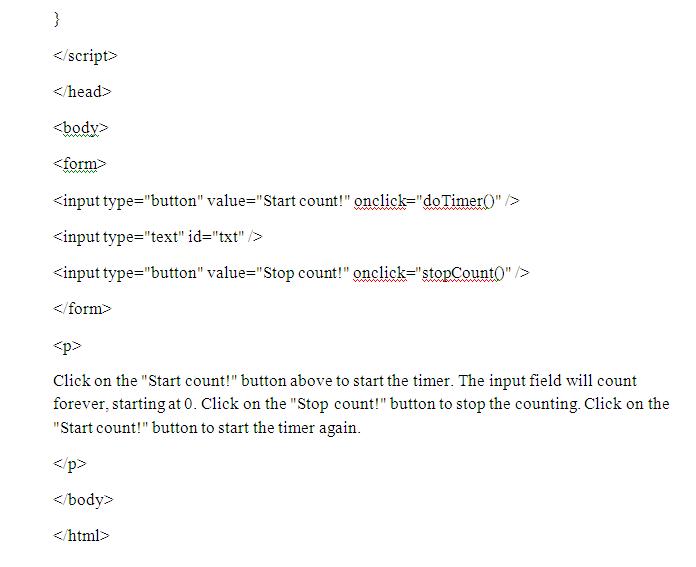
Java Script With An Example:Creating a timing event in an infinite loop


Java Script Example Help

Java Script Example: Creating a Timing event in an infinite loop with a stop button


Java Script Example Explained

Java Script Example: Creating a Clock with a Timing Event


Java Script: An Introduction

Java Script is one of the most pervasive languages found on the internet and World Wide Web. Java Script is useful in making web pages more interactive. The pages can be made to react to the actions of the users in the form of special effects, both visual and otherwise.

Java Script began as a joint effort between Netscape Communications Corporation and Sun Microsystems beginning in the year 1995. Java Script is an object-based, client-side scripting language that can be used to make web pages more dynamic.

Object-based:

Java Script can make use of items called objects. The use of objects is different in Java Script because, here the objects are not class based. There is no distinction between classes and instances.

Client-side:

Java Script is run on the client systems. Here, Java Script is run on the web browser rather than on the web server which is serving a page from the website.

Scripting Language:

A scripting language is very different from the conventional programming languages. One of the main differences is that a scripting language does not require a compiler to run the program. In a scripting language the code is interpreted as it is being loaded. This saves the time of the client.

Some of the important concepts to be kept in mind while using Java Script are

Script tags:

Script tags are used to trigger the beginning and ending of a scripting language in a HTML document. In the most basic forms, these scripting tags are seen as just any other HTML tags.

External Scripts:

External Script file is a text file that contains Java Script code. This is external script is used to run the code on a multiple pages. This is a time saving act for the client.

Variables:

A variable is used to hold value. A variable’s actual value can be altered at any point in time. Variables are used when the coder does not know the kind of values that will be used in the script. Variables can save time in writing and updating the scripts. Variables include data types such as null value, number values, Boolean values, string values, etc.

Functions:

A function can be defined as smaller script within a larger script. Functions are particularly useful for performing small tasks or a series of tasks. Functions are useful in dividing the whole script into smaller parts so that each task is handled. This makes it easier to run the whole script and debug it quickly and easily.

For more details on Java Script visit our websites at http://www.helpwithassignment.com/Java-Script-Programming-Assignment-Help and http://www.helpwiththesis.com

Saturday, October 8, 2011

Types of Security Policies in Information Technology

The policies for information security must come from all corners of an organization which includes the general staff. These Security Policies are the basis for all information security planning, design and deployment. Such Security Policies should be able to provide a direction on how the issues should be handled and what are the best technologies to be used. These policies will direct how a particular software or equipment should work. This specific information is placed in the standards, procedures and practices.

The starting and the ending point of any qualitative security programs is the policy that has been taken. These security policies are very easy to decide on but they are very difficult to implement in a proper manner.

Security Policies mostly depend upon the context in which they are used. These security policies of an organization are required to protect the information assets of an organization.

Managements often propose three types of security policies. These are

Enterprise Information Security Policies

In Enterprise Information Security Policy, a direct support is given to the organization’s mission, vision and direction. This security policy will view and direct all the security efforts. The EISP on the other hand also provides a direction in the development, implementation and management of the security program and sets out the requirements that must be met by the information security framework.

Issue-specific Security Policies

In Issue-specific Security Policy, the scope and applicability of the security policy is examined. The technologies that need to be used are addressed. Authorization of user access, privacy protection, fair and responsible use of the technology is addressed. Often, the users are prohibited from using the information in a manner that can harm others.

System-specific Security Policies

System-specific Security Policies often include standards and procedures to be implemented while maintaining of systems. This security policy is also used to address the implementation and configuration of technology as well as the behavior of the people.

Information Security Blueprint

After the organization develops the information security policies and standards, the information security department will develop the blueprint for the information security program. The information security department will list all the information assets and prioritizes the threats and dangers of the organization, a risk assessment analysis is conducted. These assessments will help in the design of the security blueprint for the organization.

This security blueprint will act as the basis for the design, selection and implementation of all security program elements including policy implementation, ongoing policy management, risk management programs, education and training programs technological controls and maintenance of the security programs.

For further details on IT Security, visit our websites at http://www.helpwithassignment.com/IT_Security_Assignment_Help and http://www.helpwiththesis.com

Information Security Principles: An understanding

A general definition of security is to being in the state of security – to be free from any kind of danger. In other words, security is protection against adversaries – from those who would harm, intentionally or otherwise. Today, we can observe the concept of security in almost every place. The most common forms of security is a unilayered or unifaceted system. But in case of organizations or the nation as such, resort to a multilayered system.

Some of the most common forms of securities that can be found in many organizations include

  • Physical security
  • Personnel security
  • Operations security
  • Communications security
  • Network security
  • Information security

Of the above forms of securities, information security is one of the major concerns today. Information security as defined by the Committee on National Security Systems, defines information security as the protection of information and its critical elements, including the systems and hardware that use, store and transmit that information.

Here the importance of information must be acknowledged. Information is one of the most valued assets today. It is because of the characteristics it possesses. Some of the characteristics that information possesses include availability, accuracy, authenticity, confidentiality, integrity, utility, possession, etc. Information Security Principles are framed by every organization. These Information Security Principles give out security protocols for securing information.

Information needs to be protected from unauthorized access. Information leakage can be dangerous for many organizations. Sometimes, information relating to the internal affairs of an organization are leaked. Such information may include the decision to implement a new type of cost cutting system, the financial information of the organization, the list of customers and their financial information, research and development information, information regarding a new product line, etc. Loosing such information can prove to be very costly for an organization. In case of government, key and strategic information is of utmost importance. Sometimes, information about national security can be at stake. Such information can include the list of weapons, testing of new weapons, key and strategic places where weapons are stored, etc.

All these kinds of information must be protected. This calls for information security approaches which can be implemented. This will include

Bottom-Up Approach: A Bottom-Up approach is the best suited approach for implementing a very good security system. One of the biggest advantages of this system is that the system or the network administrators who are using this system will implement a security system at the grassroot level. This can enhance the information security of the concern. The administrators who possess in-depth knowledge of the system will implement a right security system which would be apt for the organization in terms of their level of operations. In a way, they can help in customizing the security system.

Top-Down Approach: In this approach, the higher management of the organization will issue policy, procedures and processes to implement the type of security in the organization. This type of information security will have its own advantages. The top level management will consult experts before implementing any such system. Experts in the field can forecast future contingencies and will help in preparing for enhanced security procedures which will stop infiltrators from not only entering into the systems now, but also in the future. This will also mean that the information security will be constantly monitored and improvements in the same will be undertaken on a regular basis.

For further details on IT Security, visit our websites at http://www.helpwithassignment.com/IT_Security_Assignment_Help and http://www.helpwiththesis.com